


Overview
Over the last few months, we have received a number of questions on various spiritual topics, which Gaura Gopāla Dāsa Brahmacārī has answered. For the benefit of our readers, we are pleased to publish these questions and answers below.
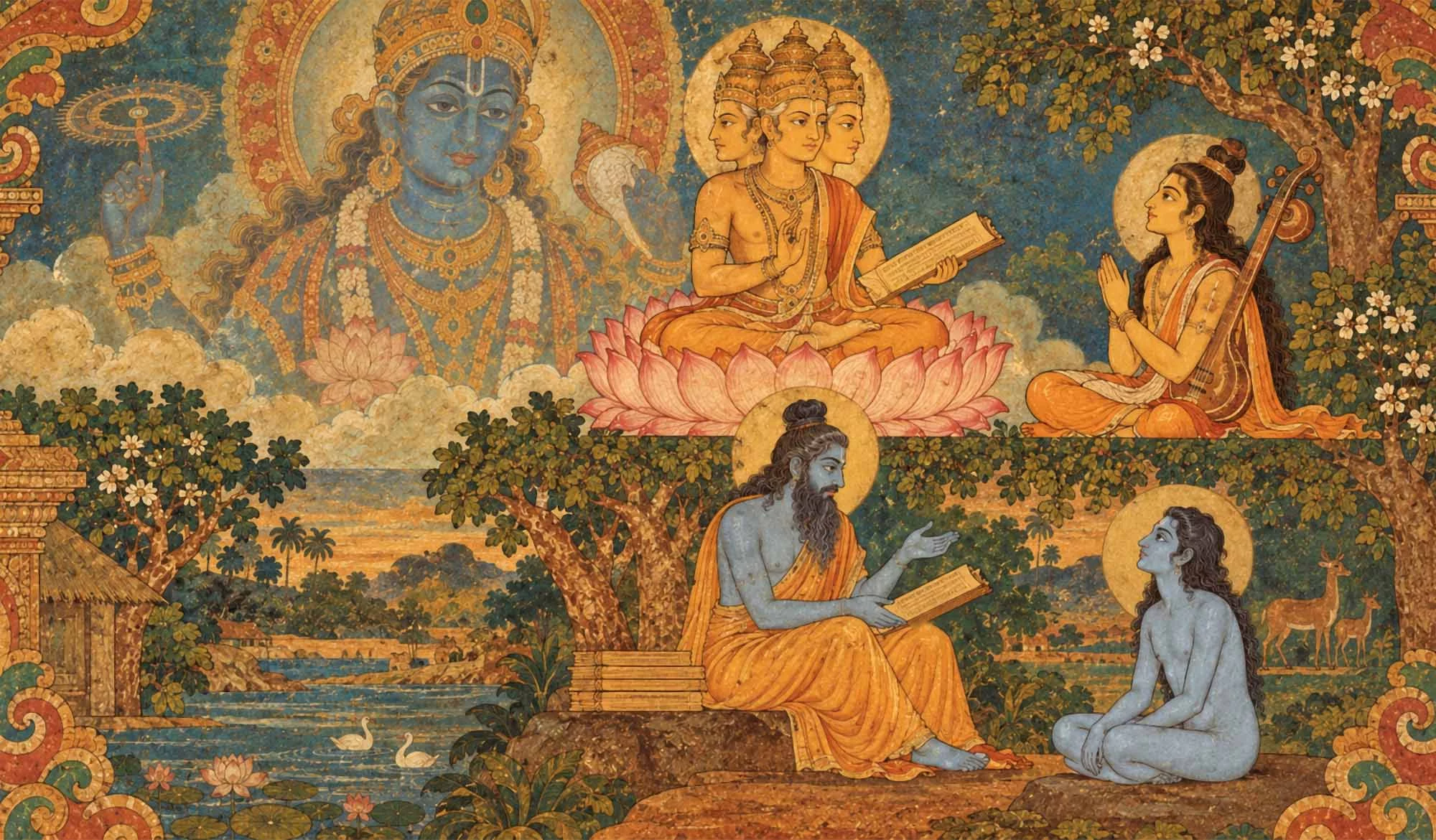
Question: Narasiṅgha Mahārāja said that the Catuḥ-ślokī was spoken by Kṛṣṇa to Brahmā, who then spoke it to Nārada and, in turn, Nārada spoke it to Vyāsa. Vyāsa then spoke it to Śukadeva, who expanded it much more and explained it to Parīkṣit Mahārāja, and later Sūta Gosvāmī heard it and recited it. After all this, it was then that Vyāsadeva penned it down. Is this chronology described somewhere in the śāstra, or has it been traced out by the ācāryas as a logical conclusion from the evidence? In particular, is there any śāstrika statement describing how the Catuḥ-ślokī was successively expanded at each stage of its transmission?
Answer: As far as I know, this is something which has been traced out by various ācāryas, but in particular I heard it from my Guru Mahārāja, who came to know of it through Śrīla Śrīdhara Mahārāja. You can find more details in Sermons of the Guardian of Devotion Vol. IV, in the section, ‘The Four Sittings of the Bhāgavatam.’
The Catuḥ-ślokī was not first given by Vyāsa to Śukadeva. The Bhāgavatam explicitly traces it back to Kṛṣṇa who spoke it to Brahmā, then Brahmā gave it to Nārada, and Nārada to Vyāsa. Then Vyāsa compiled the expanded Śrīmad Bhāgavatam and taught it to Śukadeva. Śukadeva then spoke it to Parīkṣit, and Sūta Gosvāmī later recited what he had heard.
This is like the wording of the American Declaration of Independence – “We hold these truths to be self-evident.” It is a logical and natural conclusion based on the evidence provided and the nature of the truth in the form of śāstra. The concept that many people fail to grasp is that much of the śāstra is in the form of histories, stories, and līlā which, by themselves, don’t really offer much to the reader. The reason why they are given so much weight is because they are carrying an idea, a philosophy, a conception within them. Without the teachings of Śrī Kṛṣṇa, the Mahābhārata is just a fantastic story about feuding kings. There are many sections in the Mahābhārata which contain important teachings, but the beating heart of that epic is Kṛṣṇa’s teachings to Arjuna at Kurukṣetra.
Our ācāryas, in their vocal and written expressions, are trying to translate the language of the heart into colloquial words that will capture the ear and heart of the sincere seeker. They have the realization and experience, but it is no small feat to try to express that in words which will often fall short of the experience itself. One person will read the Bhāgavatam and have a revelatory experience; another will find it too dense and boring, while another finds the stories too far-fetched and never looks at it again.
The conclusion on why the Bhāgavatam expanded the way that it did is the same as how we trace OṀ as the seed of the gāyatrī-mantra. The gāyatrī-mantra is the seed of the Vedas; the conclusion of the Vedas comes in the form of the Bhāgavatam, which itself concludes with nāma-saṅkīrtana. The seed is there, the tree grows, the tree bears fruit. We are most interested in the fruit, but it is good to be able to trace the whole process of where this fruit came from. We are not discarding anything, but we understand what is most valuable and give less attention to the secondary by-products of this whole process.
This is why the tattva-darśis are glorified. There is an ocean of sound, of conflicting conclusions even within the so-called Vedantic arena. The seers of the truth have traced out the trajectory of the essence of it all and found its natural conclusion. This is the scientific method of spiritual life. We do not need to rediscover everything for ourselves. We need only delve as far as we must in order to satisfy the doubts within through knowledge, never forgetting that this all must come to fruition in our own realizations through sacrifice, service, and action.
Question: In his lecture, ‘The History of the Sārasvata Paramparā’, Narasiṅgha Mahārāja said that there is actually no direct scriptural evidence for Mahāprabhu’s appearance. However, many devotees cite Śrīmad Bhāgavatam 11.5.32 as evidence for Mahāprabhu. Is this verse a valid scriptural reference to His appearance, or has it been interpreted in this way by later ācāryas? Are there any other scriptural passages that provide support for Mahāprabhu’s appearance?
Answer: Our Guru Mahārāja’s point is more nuanced than just saying “there is no scriptural evidence for Mahāprabhu.” There is śāstrika evidence, but the evidence is not as explicit as devotees sometimes make it sound.
As you mentioned, Śrīmad Bhāgavatam 11.5.32 states:
kṛṣṇa-varṇaṁ tviṣākṛṣṇaṁ
sāṅgopāṅgāstra-pārṣadam
yajñaiḥ saṅkīrtana-prāyair
yajanti hi su-medhasaḥ
The Supreme will appear with a non-blackish color, singing the Names of Kṛṣṇa, and accompanied by His saṅga (associates), upāṅga (servants), astra (weapons), and pārṣada (intimate companions). Those persons who are most intelligent will worship Him through the sacrifice of saṅkīrtana.
This is certainly valid evidence, but it does not specifically say. ’Gaurāṅga’ or ‘Caitanya.’ Remember, He is the channa-avatāra (hidden incarnation), so it is obvious that any śāstrika references to Him are also hidden. Those with sukṛti can understand what the śāstras are pointing at, others can’t. If the Bhāgavatam directly said, “Kṛṣṇa will come as Mahāprabhu in Kali-yuga”, then how would He be the ‘covered incarnation’?
Question: What is śuddha-bhakti? After receiving the ultimate instruction from Kṛṣṇa, Arjuna engaged himself in the war. Was that karma (I don’t think so), or was it bhakti of some inferior kind? What does it mean to follow either of them? One follows Uddhava and renounces work, while another follows Arjuna and engages in work. How do you know what to do?
Answer: It is not that Arjuna and Uddhava were engaged in some higher or lower form of bhakti. Both were engaged in śuddha-bhakti because both were following Kṛṣṇa’s will. Arjuna’s surrender meant fighting because Kṛṣṇa told him to.
You are right that it was not karma. Arjuna’s external activity was to engage in war, but it was no longer ordinary ‘work’ because he was acting on the order of Kṛṣṇa. Uddhava surrendered by leaving everything, because that was Kṛṣṇa’s instruction to him. So, surrender does not necessarily mean giving up activity. It means giving up our independent will and accepting Kṛṣṇa’s will. Sometimes that means working, and sometimes it means renouncing.
We shouldn’t just imitate Arjuna or Uddhava externally. The question we should be asking is, “What does Kṛṣṇa want me to do?” We can only learn that through guru, śāstra, and the guidance of senior devotees. Śuddha-bhakti does not mean working or renouncing, but whether we are acting for Kṛṣṇa’s pleasure.
Question: Śrīla Śrīdhara Mahārāja says, “The first position of a soul in the material world will be like that of Brahmā, the creator. Then his karma may take him to the body of a beast like a tiger…” What does this mean? Does it mean that when the jīvas first entered the material world, they were all in a position like Brahmā? Did I begin my journey in the material world as Brahmā? How should we understand this statement?
Answer: What Śrīla Śrīdhara Mahārāja says here needs to be understood carefully. He is not saying that every jīva begins his journey in the material world as a four-headed Brahmā. One cannot achieve the position of Brahmā unless one is a devotee – there are no ‘atheist Brahmās.’ Also, after his lifetime is over, the jīva who is a Brahmā goes to the spiritual world – he doesn’t devolve into the material world.
Śrīla Śrīdhara Mahārāja is basically saying that our first embodied position in the material world is in a highly elevated, ‘Brahmā-like’ position – that means as a jīva with a very refined consciousness and enormous opportunity for spiritual advancement. From there, through karma and misuse of independence, a jīva descends through various species, even to animals and plants.
So, when he says “like Brahmā,” the important word here is ‘like.’ He is describing the nature and status of our initial position here. He is not saying, “You were Brahmā and then you became a human.”
The point is that the jīva’s present position is not necessarily his original condition within the material world. He may have already descended through many species and material experiences.
Question: In Bhakti-rasāmṛta-sindhu (1.2.259), Rūpa Gosvāmī says:
dhana-śiṣyādibhir dvārair
yā bhaktir upapādyate
vidūratvād uttamatā
hānyā tasyāś ca nāṅgatā
Acts that are proclaimed to be bhakti by making use of wealth, followers, etc. are actually far away from uttama-bhakti. In fact, such acts harm the spirit of uttama-bhakti. Therefore, such acts can never be considered limbs of uttama-bhakti.
Here, Śrīla Rūpa Gosvāmī seems to be saying that dhana (wealth) cannot be an instrument or basis for uttama-bhakti. But how should we understand this practically?
Even offering bhoga to the Deities requires resources to purchase food, and running a temple, farm, or āśrama requires considerable amounts of money. There are also householders who spend eight or more hours a day working in jobs or businesses and then offer the wealth they earn in Kṛṣṇa’s service. How does Rūpa Gosvāmī’s statement apply to them? Does working to generate wealth and then using that wealth in devotional service mean that such activity is not bhakti?
Is Rūpa Gosvāmī distinguishing between different degrees or categories of bhakti here – uttama-bhakti and some lower or mixed form of devotional practice – such that the use of wealth may be compatible with one but not with the other?
Śrīla Prabhupāda seems to address this issue in his purport to Bhagavad-gītā 18.8:
One who is in Kṛṣṇa consciousness should not give up earning money out of fear that he is performing fruitive activities. If by working one can engage his money in Kṛṣṇa consciousness, or if by rising early in the morning one can advance his transcendental Kṛṣṇa consciousness, one should not desist out of fear or because such activities are considered troublesome.
How should we reconcile Śrīla Rūpa Gosvāmī’s statement in Bhakti-rasāmṛta-sindhu with Śrīla Prabhupāda’s statement that one may earn money and engage that wealth in Kṛṣṇa consciousness? What exactly is Rūpa Gosvāmī rejecting when he says that dhana cannot form part of uttama-bhakti?
Answer: There is no contradiction with Prabhupāda’s statement. Śrīla Rūpa Gosvāmī is not condemning wealth or earning money. He is distinguishing the substance of bhakti from the resources used in its service. Wealth can certainly be used in uttama-bhakti, but wealth itself does not make an activity bhakti.
A devotee may work eight hours a day and offer his earnings to Kṛṣṇa – the mere act of earning money is not bhakti simply because that money is subsequently used in devotional service. Rather, it is one’s devotional consciousness and service to which the results are offered that make the activity devotional.
Similarly, money may purchase the ingredients for Deity worship, but money is not what makes Deity worship bhakti. Thus, the verse is directed against the idea that wealth, followers, prestige, institutional power, etc., can serve as the basis or measure of one’s bhakti – not against their legitimate use in Kṛṣṇa’s service.
Another point is that those who merely give monetary donations for devotional activities should not automatically think that their giving itself constitutes uttama–bhakti (think Iskcon life-member – so many life-members do not chant, do no direct service, but just give money). Similarly, a guru should not think that simply because his disciples are engaged in service, he is necessarily making advancement through their service. The same applies to a father who engages his children, or a husband who engages his wife, in devotional service. One should not be satisfied with merely facilitating the devotion of others while neglecting one’s own cultivation of bhakti. The ideal is to desire to be personally engaged in devotional service to Kṛṣṇa. Facilitating another’s service may certainly be devotional when it is itself performed as an offering to Kṛṣṇa, but merely arranging, financing, or producing devotional activity in others does not automatically constitute uttama-bhakti on one’s own part.
Question: Rūpa Gosvāmī further says in Bhakti-rasāmṛta-sindhu (1.2.264):
sā bhaktir eka-mukhyāṅgāśritānaikāṅgikā vā
svavāsanānusāreṇa niṣṭhātaḥ siddhi-kṛd bhavet
Bhakti, taking shelter of one principal aṅga or many aṅgas according to one’s desire, and practiced with steadiness, brings about the desired result (bhāva and prema).
Could you explain this verse in more detail, particularly the meaning of svavāsanānusāreṇa – “according to one’s own innate desire”? Does Rūpa Gosvāmī mean that a devotee may take up whichever form of service he personally desires, or is this referring to a particular type of devotional inclination that develops within śuddha-bhakti?
If I choose a particular service according to my own desire, how do I distinguish that from simply doing what I want? For example, how do we distinguish service performed according to one’s devotional inclination from niṣkāma-sevā or from karma-miśra-bhakti?
In other words, what is the relationship between personal desire (svavāsanā), selfless service, and pure devotional service (uttama-bhakti)? How does Rūpa Gosvāmī’s statement here fit with his definition of uttama-bhakti as anyābhilāṣitā-śūnyam?
Answer: Svavāsānānusāreṇa does not mean that one can choose any service according to one’s material likes and call it bhakti. It means that among the various limbs of bhakti, a devotee may become particularly steady and absorbed in one (or several) limbs according to his particular inclination. This inclination concerns the manner of serving Kṛṣṇa – not the desired material result of doing that service.
Karma-miśra-bhakti is different. It is distinguished not because one has a personal preference for a particular service, but by the fact that one’s motivation for performing bhakti is mixed with a desire for the results of karma. “I am attracted to kīrtana as my service to Kṛṣṇa” is very different from “I perform kīrtana because I want some material benefit.” The former is svavāsānusāreṇa; the latter is karma-miśra.
Question: You said, “This inclination concerns the manner of serving Kṛṣṇa – not the desired material result of doing that service.” When does this inclination become apparent? Before, during, or after anartha-nivṛtti?
Answer: Naturally, these types of questions come up frequently in Kṛṣṇa conscious circles. When do certain stages of bhakti appear, along with certain feelings and certain results? These questions are natural because one wants to know more about the path of bhakti and what to expect.
At the same time, I find that while all of the expressions regarding the stages of bhakti are true, in general, they are not meant to be a roadmap to success. They are just giving a hint after observing the naturally occurring qualities of surrendered souls. Nothing in life is so clear-cut. One does not come to the path of bhakti with no śraddhā, no ruci etc. One may have a touch of these things in an incomplete way from the beginning. They develop alongside each other.
At the same time, the list is there to emphasize that without crossing anartha-nivṛtti one cannot fully develop ruci, bhāva etc. In all cases, bhakti does not manifest in a specific timeline. The aṅgas of bhakti may be delineated by the guru. It may be by inspiration after the passing of the guru. It is all a question of inspiration and connection to the real flow through guru, sādhu, and inner necessity.
There are a thousand examples you could give. If someone is getting married, do they have kids after the first year or after the first five years? If I’m getting this corporate job, will I get the promotion right away, or will I get the promotion later? How do I become CEO? There are similarities, but it’s different in every case.
Question: I wanted to ask about implementing varṇāśrama in cities.
Answer: It’s possible that I’m the wrong person to ask this question to, but I will try anyway. I grew up in the countryside in North America amongst devotees trying to live out this varṇāśrama dream. Subsequently, I have seen many farm communities and, more than anything, lots of discussions and ideas talked about by devotees over many years. Very few of these ideas come to fruition and even when they do, they all lack one thing which is critical for any chance of success – they do not have a strong spiritual head. They are Kṛṣṇa Conscious communities trying to run on a socialist system of equality without a king or a guru to guide them, and it is impossible to keep up.
What I came to find out later on was that Prabhupāda spoke a lot about varṇāśrama, but my Guru Mahārāja’s feeling was that this was for the general public more than for the devotees. Varṇāśrama is the first thing Mahāprabhu rejects in His talks with Rāmānanda Rāya on the banks of the Godāvarī. Prabhupāda was a big thinker and he dared to include the whole world in his vision. This vision did not include cities with no natural source of water, corporate jobs, and office buildings. His vision was about simplicity – cows, farming, and finding a less distracting way to practice Kṛṣṇa Consciousness.
There’s nothing wrong with farming, cows, and living a rural life. In fact, most of the time, this can be beneficial. The problem is that I find devotees become distracted and their focus becomes more about farming than becoming Kṛṣṇa conscious. They will spend their whole lives trying to roll the clock back to an earlier time when farming was more glorious.
Previously, in every village in India, there was somebody making ox carts, wheels for the ox carts, training the bullocks to plow the field, plowing them with traditional methods, sowing seeds by hand – all of these things were going on. The whole environment supported that. Now, if you try and do that, it’s more expensive and more difficult to do things the traditional way than it is to buy a tractor and farm with modern methods. You have to be a man of money and means to live simply. It is an unfortunate result of the phasing out of so many traditional ways of living. The world has changed and is continuing to change rapidly.
I grew up in my guru’s āśrama in South India. There we farmed, lived simply, had cows, worshipped the Deity, and lived next to a natural source of water, the Kāverī river. This was possible because there was one head with a clear direction for the handful of people living there. Most people cannot and will not live in this type of environment, even when it is idyllic bordering on heavenly.
In conclusion, you cannot implement varṇāśrama in the city. Prabhupāda’s vision of varṇāśrama was that the householders stay in farm communities, and the temples in the cities should be run by sannyāsīs and brahmacārīs who would preach to the average people to try and bring them to a simpler way of living and to engage in Kṛṣṇa Consciousness.
Related Articles
- A Letter to the Editor of the Navbharat Times by Śrīla A.C. Bhaktivedānta Swami Prabhupāda
- Grantha Samālocanā (A Book Review) by Śrīla A.C. Bhaktivedānta Swami Prabhupāda
- A Letter – from Disciple to Guru
- A Second Letter – From Disciple to Guru
- An Open Letter to an ISKCON GBC by Swami B.G. Narasiṅgha Mahārāja
- Śrīyā Śuka by Swami B.G. Narasiṅgha Mahārāja
- Heresy, Inquisition, Jihad, Fatwa and the Hare Kṛṣṇas by Swami B.G. Narasiṅgha Mahārāja
- Scholarship vs Divine Revelation by Swami B.G. Narasiṅgha Mahārāja
- Pilgrimage to Vṛndāvana-dhāma by Swami B.G. Narasiṅgha Mahārāja
- The Sārasvata Paramparā and the Caste-Brāhmaṇa Guru by Swami B.V. Giri
- An Essential Teaching about the Bhāgavat-Paramparā by Swami B.V. Giri
- Did Bhaktivinoda Ṭhākura Advocate Caste Brahmanism? by Gaura Gopāla Dāsa
- Appeasing Critics or Honouring the Ācāryas? by Gaura Gopāla Dāsa
- Never Leave Iskcon? by Gaura Gopāla Dāsa
- That’s an Offense! by Gaura Gopāla Dāsa
- “It’s Kali-yuga, Prabhu!” Suffering in Spiritual Life by Gaura Gopāla Dāsa
Further Reading from the Bhaktivinoda Institute
- ‘Tattva Sāra’ (A book by a follower of Ramakrishna) by Śrīla Bhaktivinoda Ṭhākura
- Siddhānta-Ratna – Written by Śrīyukta Upendra-mohana Gosvāmī of Khaḍadara by Śrīla Bhaktivinoda Ṭhākura
- Samālocana (A Book Review) by Śrīla Bhaktivinoda Ṭhākura
- Samālocanā (A Critique of the book ‘Vanamālā’) by Śrīla Bhaktivinoda Ṭhākura
- Samālocana (A Critique) by Śrīla Bhaktivinoda Ṭhākura
- A Critique of the Book: An Ocean of Mṛdaṅga Beats (Samālocana: Mṛdaṅga Vādyārṇava) by Śrīla Bhaktivinoda Ṭhākura
- A Critique of the Book Rasa Śaivalinī Gītā (Samālocana – Rasa Śaivalinī Gītā) by Śrīla Bhaktivinoda Ṭhākura
- A Critique of the Book Śrī Gīta Govinda (Samālocana – Śrī Gīta Govinda) by Śrīla Bhaktivinoda Ṭhākura
- Śrī Caitanya-bhāgavata by Śrīla Bhaktivinoda Ṭhākura
- Prabodhānanda and Prakāśānanda by Śrīla Bhaktivinoda Ṭhākura
- Śrī Muralī Vilāsa by Śrīla Bhaktivinoda Ṭhākura
- Vaiṣṇava Granthāvalī by Śrīla Bhaktivinoda Ṭhākura
- Śrī Bhāgavatācārya by Śrīla Bhaktivinoda Ṭhākura
- Yugāvatāra by Śrīla Bhaktivinoda Ṭhākura
- Bhakti Caitanya Candrikā by Śrīla Bhaktivinoda Ṭhākura
- Impersonal Spirituality and Transcendental Spirituality (Ādhyātmika u Aprākṛta) by Śrīla Bhaktivinoda Ṭhākura
- A Critique: Śrī Śrī Caitanyadeva and Prema Dharma (Samālocana – Śrī Śrī Caitanyadeva o Prema Dharma) by Śrīla Bhaktivinoda Ṭhākura
- Bhakti Caitanya Candrikā by Śrīla Bhaktivinoda Ṭhākura
- Nūtana Patrikā (A New Magazine) 1 by Śrīla Bhaktivinoda Ṭhākura
- Nūtana Patrikā (A New Magazine) 2 by Śrīla Bhaktivinoda Ṭhākura
- A Review of Nitya-rupa-sangsthapanam – A Sanscrit Work by Śrīla Bhaktivinoda Ṭhākura