


Overview
The following is from a Bengali class given by Śrīla Śrīdhara Deva Gosvāmī, which was later published in Śrī Gauḍīya Darśana magazine, Vol.3, Issue 2, 1957. Śrīla Śrīdhara Mahārāja connects the appearance of Vāmana and Śrī Jīva, and extols the glories of Jīva Gosvāmī.
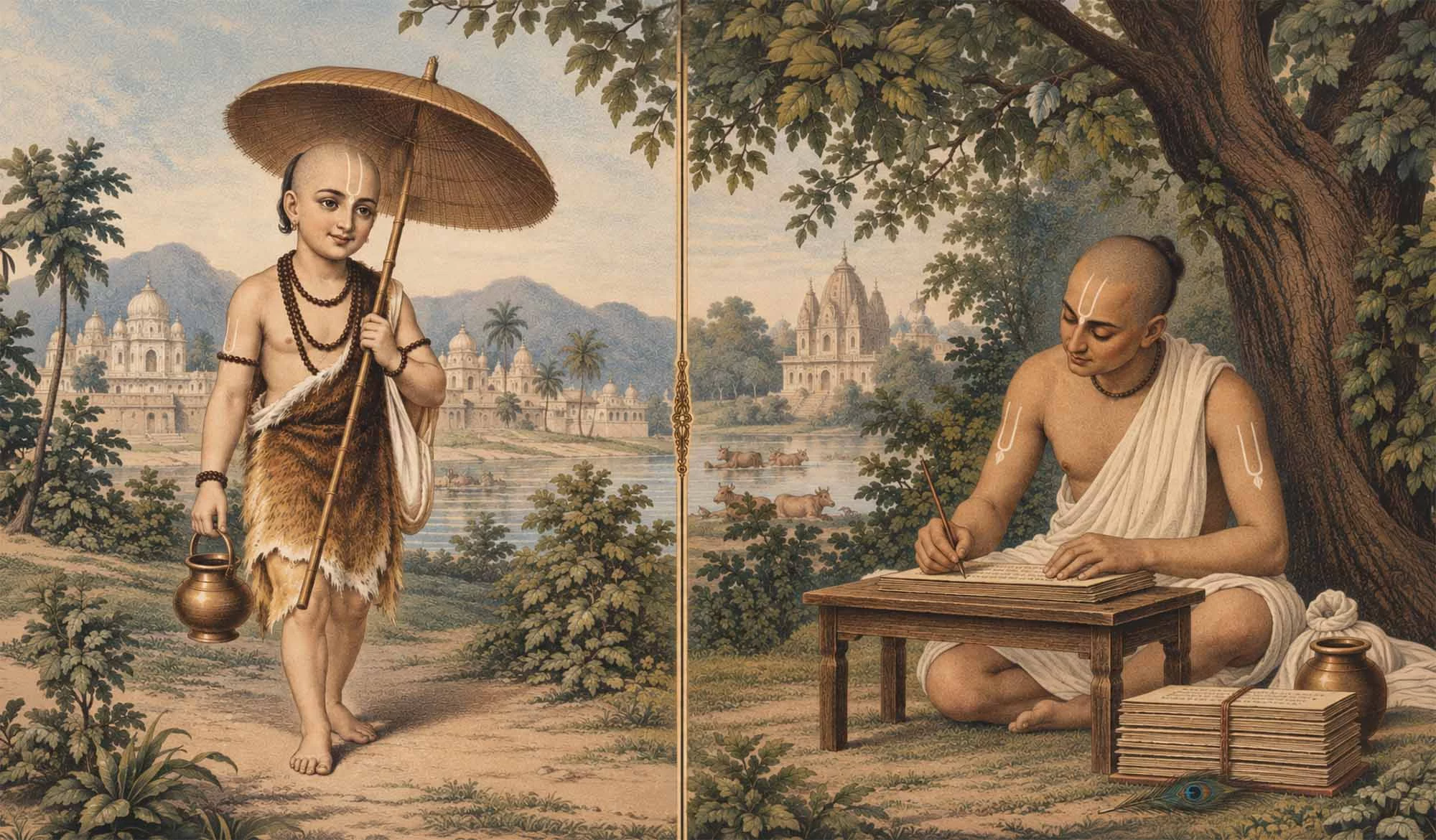
Today is the appearance day of Śrī Vāmanadeva. He appeared on the occasion of Śuklā Dvādaśī (the twelfth lunar day of the waxing moon) in order to deliver the Devas from the clutches of the Asuras. In the same way, Śrīla Śrī Jīva Gosvāmī Prabhu appeared on this tithi for the purpose of establishing śuddha-bhakti by refuting the various atheistic and materialistic doctrines that had filled the world.
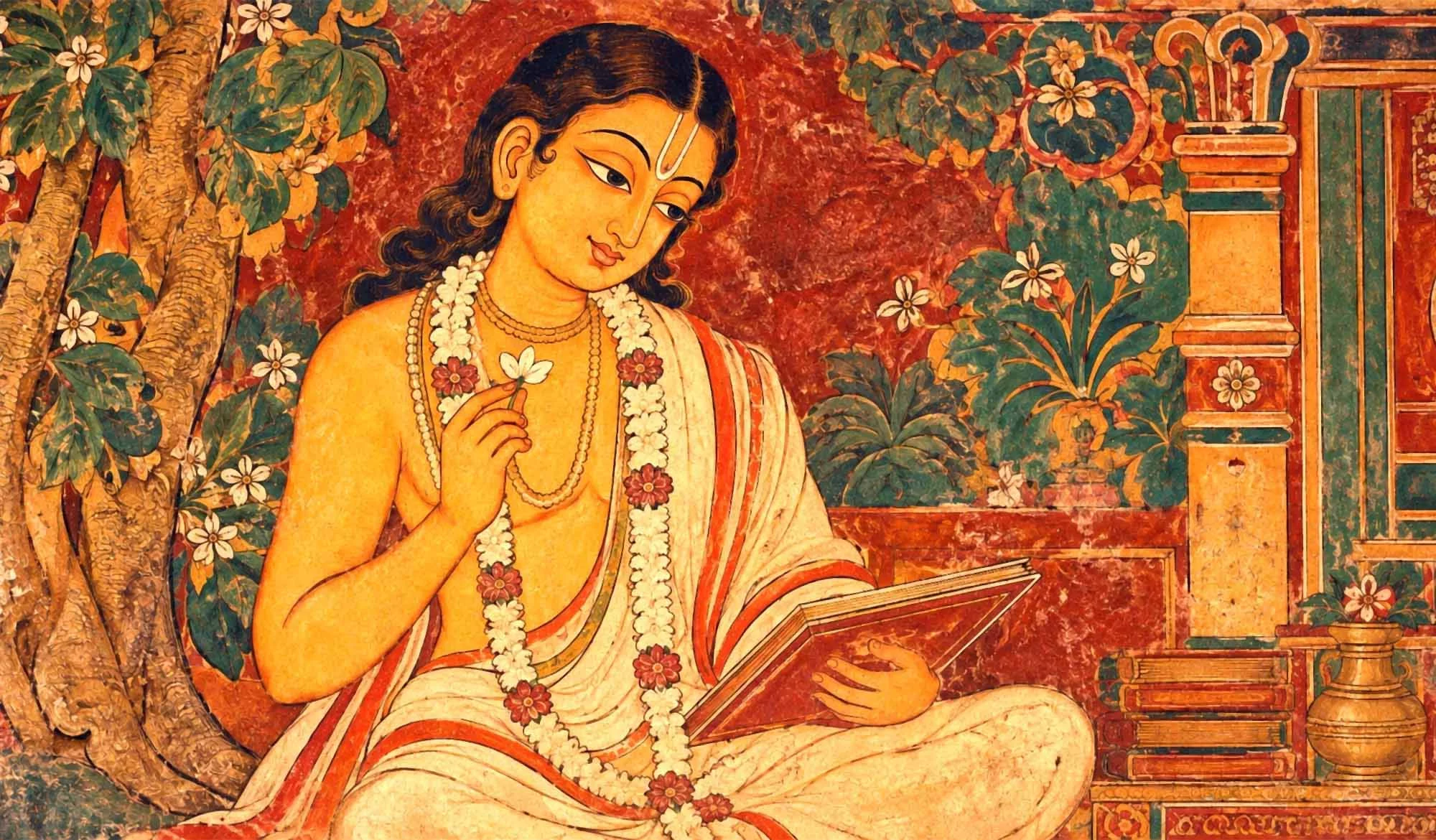
We see Śrī Jīvapāda as one of the foremost ācāryas. His spotless life is exceedingly glorious. He was born in a royal family, and his activities were befitting a prince. Yet, although he was a prince, he accepted the dress of a sannyāsī and lived a life of devoted obedience to Śrīla Rūpa and Sanātana. From the perspective of worldly relationships, Śrīla Rūpa and Sanātana were his elders and relatives. Although Śrīla Rūpa and Sanātana were learned in all the śāstras, after coming into contact with Śrī Caitanyadeva they did not spend their time discussing philosophical treatises concerned with worldly doctrines; rather, they devoted more of their time to studying transcendental śāstras such as the Śrīmad Bhāgavatam.
Śrī Jīva Prabhu, however, for the protection of the conclusions of bhakti and the preservation of the glory of the sampradāya, studied the philosophical works containing the atheistic doctrines of Sāṅkhya, Mīmāṁsā and so forth. He shattered the mountain of scholarly pride possessed by those who considered themselves great paṇḍitas, thereby establishing the dignity and glory of the teachings propagated by Śrī Gaurasundara, his master’s Master. In this way, like a mine of jewels headed by the brilliant jewel known as the Śrīmad Bhāgavata-siddhānta-cintāmaṇi (the jewel-like conclusions of the Bhāgavata), he illuminated the firmament of the world’s fortune with its radiant light.
Once, in Vṛndāvana, a digvijayī-paṇḍita – the embodiment of pride in various forms of mundane religious learning – approached Śrīla Rūpa and Sanātana, seeking to engage them in śāstrika debate in the hope of achieving victory over them. Rather than waste their time in discussions of external, mundane śāstrika doctrines, they willingly gave him a jaya-pātra (a certificate of victory), thereby manifesting their līlā of deliberate deception.
However, hearing of the scholarship of Śrī Jīvapāda, the paṇḍita approached him. With great pride, he showed him the jaya-pātra bearing the signatures of Śrīla Rūpa and Sanātana and instructed him to sign it as well. Śrī Jīva Prabhu, who was determined to uphold the dignity of the guru-varga, immediately tore up the document and engaged him in a śāstrika debate. Within a short time, he defeated the paṇḍita and declared the truth concerning the deceptive līlā of Śrī Rūpa and Sanātana. He thereby demonstrated how truly great and exalted they were, and how elevated was the position illumined by the radiance of their toenails. In his endeavour to establish the dignity of the śrī–guru-varga, Śrī Jīva Gosvāmī Prabhu paid no heed whatsoever to the harsh words or critical glances of inexperienced people in the world.
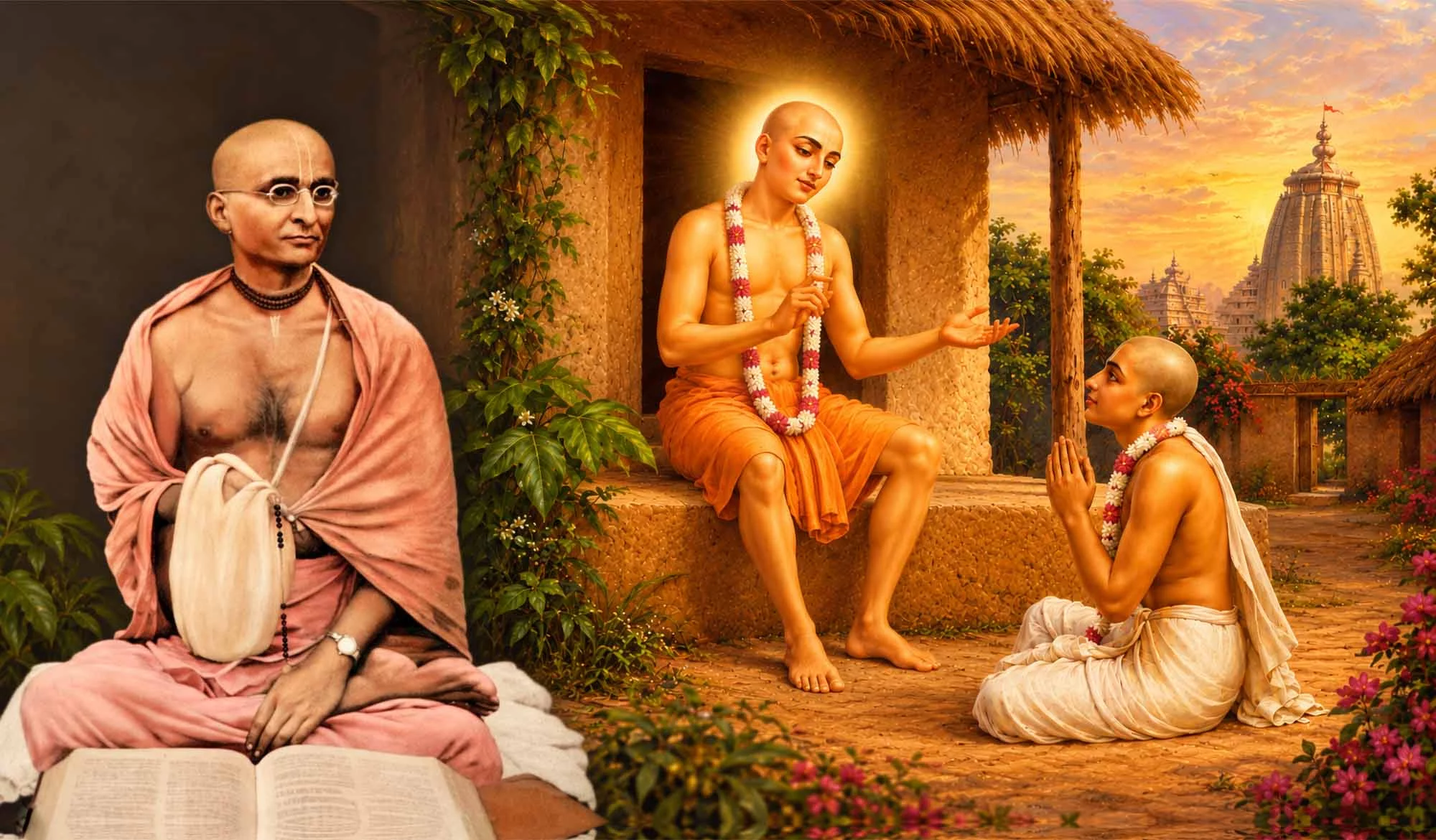
Thereafter, a similar endeavour to that of Śrī Jīva Gosvāmī Prabhu can be seen in the example of our guru-pāda-padma, Śrīla Bhaktisiddhānta Sarasvatī Ṭhākura. He too brought the true spiritual wealth of the akincana Vaiṣṇava mahājanas before the world, thereby bringing welfare to humanity. For this purpose, through multifaceted efforts, extraordinary genius and remarkable spiritual vigour, he removed from the learned community misconceptions concerning dharma, adharma, and attempts to increase material enjoyment through the gratification of the senses in the name of religion. In this way, he established the true nature and dignity of śuddha-bhakti.
Through his writings, Śrī Jīva Prabhu glorified and endowed the simple, natural and spontaneous loving service of Vrajendra-nandana with dignity. In this connection, the following incident may be mentioned.
While in Śrī Purī-dhāma, on the occasion of Herā Pañcamī, Śrīvāsa Paṇḍita, a servant of Śrī Lakṣmī-Nārāyaṇa, witnessed the Vijaya Utsava of Śrī Lakṣmī. Proud of the opulence of his mistress, Śrī Lakṣmī Ṭhākurāṇī, he playfully began to extol the magnificence and splendour of Vaikuṇṭha-dhāma.
At this, Śrī Svarūpa Dāmodara, the intimate servant of the Vraja-vihārī Śrī Rādhā-Govinda, said, “All the opulence of Vaikuṇṭha exists beneath the wealth of Vṛndāvana-dhāma, which is beautifully adorned with flowers, tender shoots, mountain minerals, peacock feathers, guñjā berries and other natural ornaments. Therefore, those who possess the wealth of Vraja do not desire any other wealth.”
Hearing of the supreme glory of the inhabitants of Vraja, Śrīman Mahāprabhu and Śrīvāsa Paṇḍita, overwhelmed with ecstatic prema, began to dance repeatedly.
Śrī Jīva Gosvāmī Prabhu, as a follower of Śrī Rūpa, protected society from deviation by presenting the doctrine of svakīyavāda, which preserves and reveals the eternal relationship between the Potency and the Possessor of the Potency (śrī-śakti and śaktimān), the underlying foundation of the transcendental parakīya-rasa. He did so for the welfare of those who are incapable of understanding the essential nature of pure parakīya-rasa. A similar doctrine of svakīyavāda is also found in the Nimbārka sampradāya.
Śrīla Kavirāja Gosvāmī Prabhu has likewise written as follows:
gopāla-campū nāme grantha mahāśūra
nitya-līlā sthāpana yāhe vraja-rasa-pūra
The great work known as Gopāla-campū establishes the eternal līlā, and the rasa of Vraja is fully described therein. (Caitanya-caritāmṛta, Madhya-līlā 1.44)
Therefore, the gopīs of Vraja are eternally united with the Supreme Lord in their constitutional relationship, and there is no scope for perceiving any fault in the parakīya-rasa there. However, for the enhancement of rasa, Yogamāyā arranges the service of Kṛṣṇa in such a way that the appearance of parakīyatva is manifested in the eternal līlā. Thus, the wonderful nature of the nitya-līlā becomes fully manifest within the hearts of the devotees, while remaining united with its indivisible and complete reality.
Śrī Jīva Gosvāmī Prabhu remains the crest-jewel of the learned society, having made available to the world its own true wealth, kṛṣṇa-prema-bhakti. To this end, through the composition of works such as Śrī Hari-nāmāmṛta-vyākaraṇa, he has given the jīvas the opportunity to chant hari-nāma at every moment.
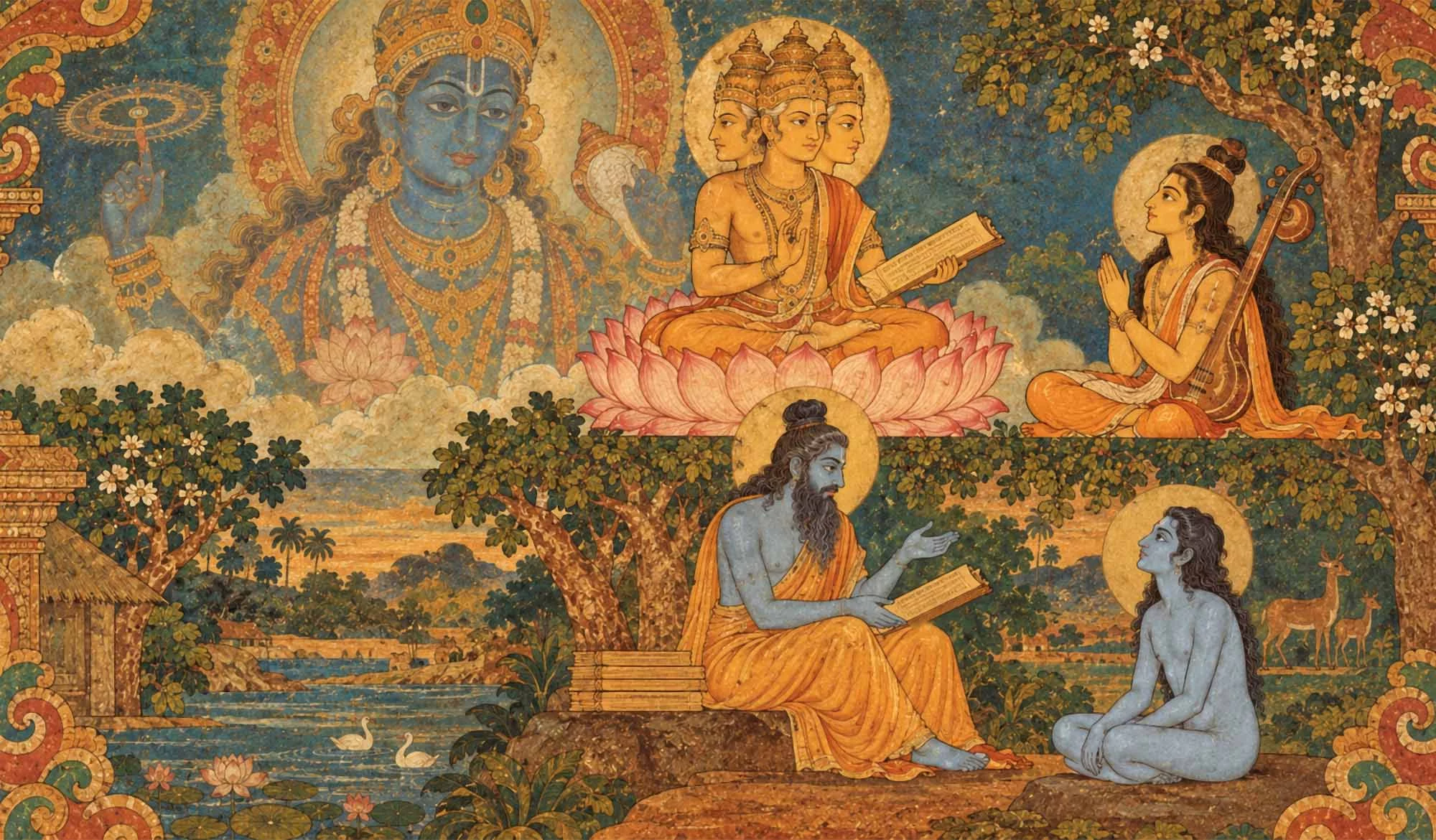
In his Ṣaṭ-sandarbha and other works, he churned the milk of the Veda and Purāṇas and established Śrīmad Bhāgavata, the very essence of that churning, as the crown jewel of all śāstras. Within it are found, in their entirety, all varieties of śāstra, including śruti, smṛti, nyāya etc. In determining the nature of sambandha-tattva, among the three conceptions presented in the Śrīmad-Bhāgavatam – Brahman, Paramātmā and Bhagavān – Svayam-Bhagavān Śrī Kṛṣṇa, the son of Nanda Mahārāja, who possesses the characteristics of Svayam-rūpa, is established as the highest conception of sambandha-tattva.
In the abhidheya-tattva, after examining the relative positions of karma, jñāna, yoga and other paths, he demonstrated the insufficiency of such practices and established one-pointed devotion based upon surrender to Bhagavān as the true abhidheya-tattva.
In determining the prayojana-tattva, he established that kṛṣṇa-prema-bhakti alone is the fifth and highest puruṣārtha (goal of human life). By examining the successive stages described in the Śrīmad Bhāgavatam and other scriptures, he demonstrated that liberation endowed with the characteristics of devotion is the highest conclusion of scriptural deliberation. Impersonal, dry liberation is condemned according to the Śrīmad Bhāgavatam. When all these points are carefully considered by following the conclusions of the wise, Kṛṣṇa-prema-bhakti is understood to be the highest form of liberation available to the jīva.
Among all the śāstras, the Śrīmad Bhāgavatam is said in the śāstra to be the revelation of the conclusions preached by Śrī Kṛṣṇa Caitanyadeva and the authentic expression of the meaning of Brahma-sūtra, or Vedānta-darśana. For this reason, Śrī Jīva Gosvāmī Prabhu did not compose a separate commentary on the Brahma-sūtra or Vedānta-darśana. In this connection, it may be mentioned that many eminent scholars have said that if Śrī Jīva Gosvāmī had composed a commentary on the Brahma-sūtra or Vedānta-darśana, the other commentaries would have been rendered insignificant or meaningless.
Śrī Jīva Gosvāmī Prabhu lived a long life as a lifelong brahmacārī. In Vṛndāvana, he manifested the service of Śrī Rādhā-Dāmodara. When Śrī Kṛṣṇa Caitanyadeva was at Rāmakeli village, Śrī Jīva Gosvāmī was still a young boy. Later, he went to Navadvīpa and approached the lotus feet of Śrī Nityānanda Prabhu. Śrīman Nityānanda Prabhu took Śrī Jīva Gosvāmī Prabhu with him on a pilgrimage of Śrī Navadvīpa-dhāma, the seat of the ninefold devotional practices. From there, Śrī Nityānanda Prabhu instructed Śrī Jīva Prabhu, “Go to Vṛndāvana. There, the Lord has established your family – you should go there.”
Following the order of Śrī Nityānanda Prabhu, Śrī Jīva Prabhu stayed for some time in Kāśī on his way to Vṛndāvana. There, he studied with Madhusūdana Vācaspati the commentaries on the Brahma-sūtra, or Vedānta-darśana, and related subjects – the essence of the teachings that Śrī Caitanyadeva had imparted to Paṇḍita Sārvabhauma.
He then went to Vṛndāvana and took shelter of the feet of Śrī Rūpa and Sanātana, remaining there peacefully engaged in their service. Although he was a great scholar, he established by his own conduct the ideal of serving the Vaiṣṇavas who considered themselves akincana, possessing nothing of their own. Gradually, Śrī Sanātana and Śrī Rūpa Prabhu entered their aprākṛta–līlā.
Later, Śrī Śyāmānanda Prabhu came to be recognised as his disciple. At first, he had taken shelter of sakhya-rasa, but subsequently he received initiation and instruction in mādhurya–rasa from Śrī Jīva Prabhu. Śrī Śyāmānanda Prabhu, Śrīla Narottama Ṭhākura and Śrīla Srinivāsa Ācārya, the three great preachers, following his order, extensively propagated in this land the teachings of pure kṛṣṇa-bhakti as presented in the writings of the Gosvāmīs.
Regarding Śrī Gosvāmī Prabhu, Śrīla Bhaktivinoda Ṭhākura has sung:
śrī-jīva-gosvāmī kabe siddhānta-salile
nivāibe tarkānala citta yāhe jvale
When will Śrī Jīva Gosvāmī, with the waters of established conclusions, extinguish the fire of argument that burns my heart? (Kalyāṇa Kalpataru,Ucchvāsa 1 – Song Four)
In other words, owing to impressions from previous lives, various doubts, arguments and false reasonings arise and contaminate the heart of the jīva, preventing him from advancing on the path of bhagavat-bhakti. By the mercy of Śrī Jīva Prabhu, all such undesirable impressions are removed, and the truth concerning Bhagavān becomes manifest.
Doubts, arguments and so forth exist within every jīva in varying degrees. When he is pleased with us, we may attain a life filled with faith in Bhagavān – a life that grants us entrance into the service and attendance of the Supreme Person, a life imbued with rasa. By attaining such a life, we can become supremely blessed.
Therefore, on this auspicious tithi, let us pray for his mercy. May he be pleased with us.
yaḥ sāṅkhya-paṅkena kutarka-pāṁśunā
vivarta-garttena ca lupta-dhītim
śuddhaṁ vyadhād vāg-sudhayā maheśvaraṁ
kṛṣṇaṁ sa jīvaḥ prabhur astu me gatiḥ
With his nectarean words, Śrī Jīva revealed Kṛṣṇa, the Supreme Lord, whose effulgence had been concealed by the mud of sāṅkhya, the dust of nyāya, and the pit of māyāvāda. May he be my refuge.
While composing his commentaries on works such as the Tattva-sandarbha, Śrī Baladeva Vidyābhūṣaṇa Prabhu offered his obeisance unto Śrī Jīva Prabhu through this śloka. Following his example, we too pray to Śrī Jīva Prabhu for our spiritual welfare.
(Translated by Swami Bhaktivijñāna Giri)
Related Krishna Talk Articles:
- 📚 Prema Dhāma Deva Stotram Series Index
- Prakaṭa Pūrṇimā (The Appearance of the Full Moon) by Śrīla Bhaktisiddhānta Sarasvatī Ṭhākura
- Śrī Sarasvatī Saṅlāpa (A Discourse by Sarasvatī Ṭhākura) by Śrīla Bhaktisiddhānta Sarasvatī Ṭhākura
- Śrī Gaura ki Vastu? (Who is Sri Gaura?) by Śrīla Bhaktisiddhānta Sarasvatī Ṭhākura
- The ‘Vṛndāvana Express’ and the ‘Navadvīpa Special’ by Śrīla Bhakti Rakṣaka Śrīdhara Mahārāja
- Our Prospect is Through Gaura-Līlā by Śrīla Bhakti Rakṣaka Śrīdhara Mahārāja
- Paṇḍita Śrī Gadādhara Gosvāmī by Śrīla Bhakti Rakṣaka Śrīdhara Mahārāja
- The Magnanimous Nature of Nityānanda Prabhu by Śrīla Bhakti Rakṣaka Śrīdhara Mahārāja
- Makara Saṅkrānti by Śrīla Bhakti Rakṣaka Śrīdhara Mahārāja
- Śrī Gaura-līlāmṛṭa-sāra (The Essence of the Nectar of Śrī Gaura-Līlā) by Śrīla Bhakti Pramoda Puri Gosvāmī
- Mahāprabhu as Rasarāja-Mahābhāva by Śrīla Bhakti Gaurava Narasiṅgha Mahārāja
- Mahāprabhu as Prabhupāda by Śrīla Bhakti Gaurava Narasiṅgha Mahārāja
- The Five Precepts of Śrī Caitanya Mahāprabhu
- Everything is by Mahāprabhu’s Grace by Śrīla Bhakti Gaurava Narasiṅgha Mahārāja
- Mahāprabhu’s Mudrā by Śrīla Bhakti Gaurava Narasiṅgha Mahārāja
- The Worship of Gaura-Gadādhara by Śrīla Bhakti Gaurava Narasiṅgha Mahārāja
- This Saṅkīrtana Movement Is the Līlā of Mahāprabhu by Śrīla Bhakti Gaurava Narasiṅgha Mahārāja
- Nityānanda Avadhūta by Śrīla Bhakti Gaurava Narasiṅgha Mahārāja
Further Reading from the Bhaktivinoda Institute:
- 📖 Śrīman Mahāprabhura Śikṣā by Śrīla Bhaktivinoda Ṭhākura (Book)
- 📖 Śrī Navadvīpa-dhāma Māhātmya by Śrīla Bhaktivinoda Ṭhākura (Book)
- 📖 Gaurāṅga-līlā-smaraṇa-maṅgala Stotram by Śrīla Bhaktivinoda Ṭhākura (Book)
- 📖 Śrī Navadvīpa Bhāva Taraṅga by Śrīla Bhaktivinoda Ṭhākura (Book)
- 📖 Chaitanya Mahaprabhu His Life and Precepts by Śrīla Bhaktivinoda Ṭhākura (Book)
- 📖 Śrī Caitanya Upaniṣad by Śrīla Bhaktivinoda Ṭhākura (Book)
- 📖 The Essence of the Ten Foundational Principles (Daśa Mūla Niryāsa) by Śrīla Bhaktivinoda Ṭhākura (Book)
- The Non-Difference Between Śrī Gaura and Kṛṣna by Śrīla Bhaktivinoda Ṭhākura
- Prema-Bhakti and Śrī Gaurāṅgadeva by Śrīla Bhaktivinoda Ṭhākura
- The Sunrise of Eternal Dharma by Śrīla Bhaktivinoda Ṭhākura
- A dispute about Śrī Śrī Mahāprabhu by Śrīla Bhaktivinoda Ṭhākura
- A New Gaurāṅga by Śrīla Bhaktivinoda Ṭhākura