


Overview
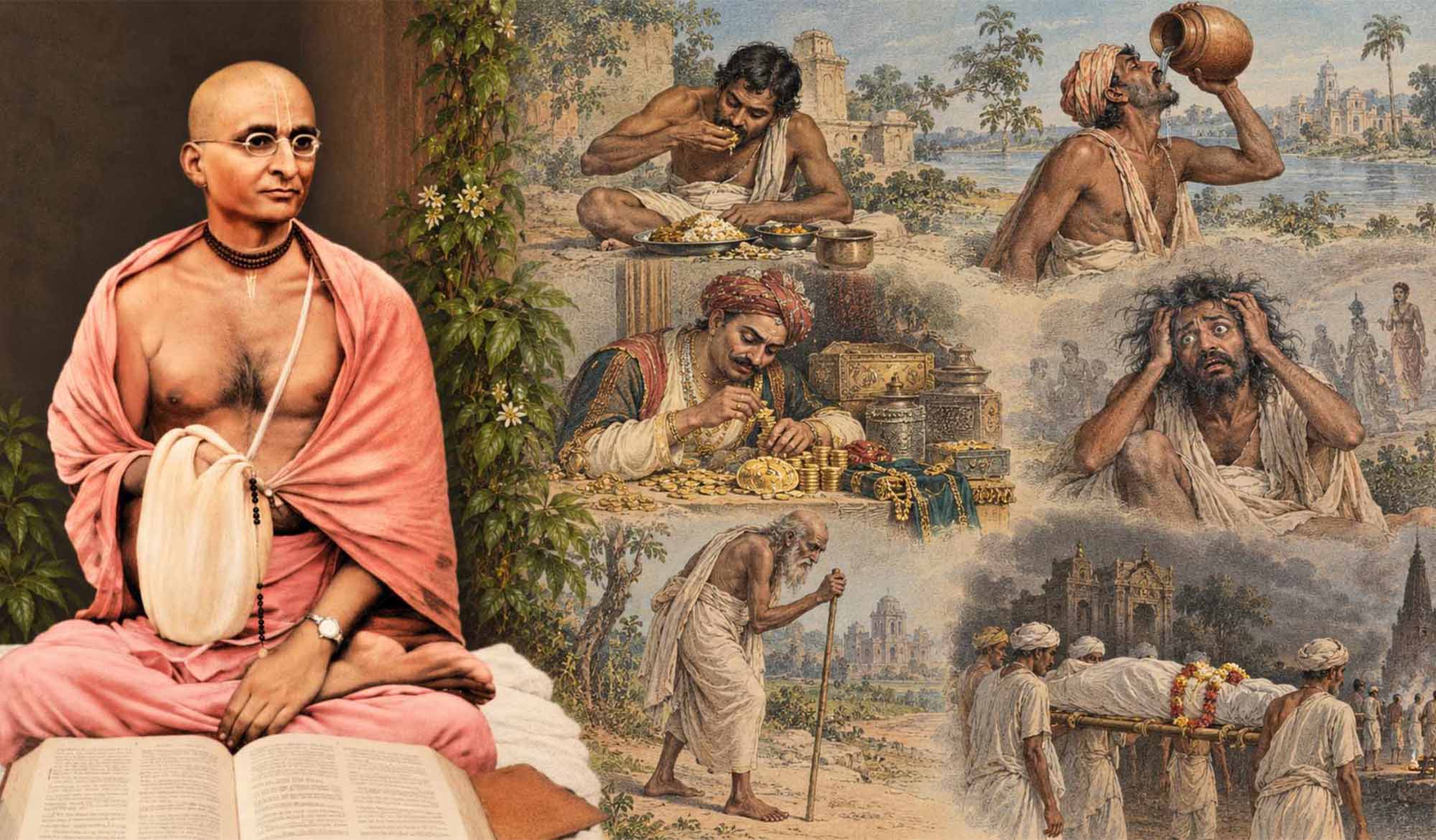
Continuing Śrīla Sarasvatī Ṭhākura's teachings on the twenty-six qualities of a devotee, this essay examines vijita ṣaḍ-guṇa – conquering the six qualities of hunger, thirst, greed, delusion, old age and death. A devotee who takes exclusive shelter of Kṛṣṇa remains untouched by these material transformations, and by taking shelter of such devotees, a conditioned jīva can also attain pure bhakti.
The six qualities are kṣudhā (hunger), pipāsā (thirst), lobha (greed), moha (delusion), jarā (old age) and mṛtyu (death). Some say that the six opposing qualities – lust, anger, greed, delusion, pride and envy – are the six opposing qualities.
These six qualities are the nature of anātmā (not the ātmā, or self). Anātma is understood in relation to the body and mind. When the conscious faculty, or the faculty of the ātmā, predominates in the cultivation of matter, or anātma, then that particular consciousness is defined as the mind. The mind, with the help of the ego, focuses on material objects. In the realm of material nature, the influence of the three modes of nature, the guṇas, is observed. All impermanent actions arise from the guṇas. When the conscious faculty is driven by the guṇas, one becomes the enjoyer of the results of action. When the mind is subject to the results of karma, it is said to have been conquered by the six qualities. By being free from the enjoyment of the results of action, or by renouncing karma-kāṇḍa, one can become a sādhu. At that time, he has no desire whatsoever for material enjoyment. A great personality who is transcendental to the three guṇas is not subject to the six qualities. These extraneous qualities exert their influence upon objects that are not in connection with the self (anātma–vastu). The six qualities have no dominion over a devotee.
A devotee appears, from the material point of view, to be just like other human beings who enjoy the results of their actions. However, being ātmavit (a knower of the self), through intelligence founded upon taking shelter of Kṛṣṇa, he remains untouched by enjoyment. His activities are eternally devoted to the service of Hari. Both the karmī and the jñānī must remain subject to the six qualities, but a devotee is never subject to them. A devotee knows that the ātmā possesses eternal characteristics; transient, extraneous characteristics cannot touch it.The transformations produced in the body and mind by the guṇas do not affect the intelligence of a devotee; he himself remains entirely detached from these six qualities.
Where the grotesque dance of anger etc. is observed in someone recognised as a devotee, the ordinary observer’s reverence for that person diminishes. Again, when faced with the frenzied dance of violence, envy and hatred of those who are hostile to the devotees, the devotee’s corresponding behaviour – as one who has conquered the six qualities – remains unaffected. Because these qualities produce transformations in the body and mind, they are not attributes of a devotee who is ātmavit. Although that group of six qualities remains unmanifest in the peaceful state of the jñānī, they become agitated again and again, producing material transformations. Because the devotee has taken exclusive shelter of Kṛṣṇa, he cannot be touched by any such transformation.
For this very reason, the book of the paramahaṁsas, Śrīmad Bhāgavatam, also known as the Pāramahaṁsa-saṁhitā, has revealed the characteristics of virtuous, non-envious persons (sajjana nirmatsara), or those who have conquered the six qualities.
Simply by understanding that a devotee has conquered the six qualities, a bound jīva can also become a devotee. However, as long as he judges the concept of a devotee with a narrow intellect, he will be unable to understand the state of one who has conquered the six qualities. When a jīva becomes qualified to behold the pure lotus feet of the devotees who have conquered the six qualities, that jīva also becomes a devotee.
Related Articles & Books
- 📚 Twenty-six Qualities of a Devotee Series by Śrīla Bhaktisiddhānta Sarasvatī Ṭhākura
- Vaiṣṇava Nindā by Śrīla Bhaktivinoda Ṭhākura
- The Country’s Misfortune by Śrīla B.R. Śrīdhara Mahārāja
- Śiva-tattva & the Position of Lord Śiva by Śrīla B.R. Śrīdhara Mahārāja
- Oh Bābā! Bolacche-re! by Śrīla B.R. Śrīdhara Mahārāja
- Problems and Solutions by Śrīla B.R. Śrīdhara Mahārāja
- The Highest Attainment and Present Adjustment by Śrīla B.R. Śrīdhara Mahārāja
- Āgun Jvālbe (Light the Fire!) by Śrīla B.R. Śrīdhara Mahārāja
- Dharma and the Modern World by Śrīla A.C. Bhaktivedānta Swami Prabhupāda
- Faith Confirms the Absolute by Śrīla B.G. Narasiṅgha Mahārāja
- Go Deeper! by Śrīla B.G. Narasiṅgha Mahārāja
- To Be a Servant by Śrīla B.G. Narasiṅgha Mahārāja
- Harmony – Real and Apparent by Swami B.V. Giri
- The Definition of Faith by Gaura Gopāla Dāsa
- Ātma Samīkṣā – The Value of Introspection by Kalki Dāsa
- Frogs in the Well of Prejudice by Kalki Dāsa
Further Reading from the Bhaktivinoda Institute
- Śraddhā (Faith) – Quotes by Bhaktivinoda Thakura
- Śraddhā and Śaraṇāgati by Śrīla Bhaktivinoda Ṭhākura
- The Association of Sādhus by Śrīla Bhaktivinoda Ṭhākura
- Epilogue to Śrī Kṛṣṇa Karṇāmṛta by Śrīla Bhaktivinoda Ṭhākura
- Prīti (Love) by Śrīla Bhaktivinoda Ṭhākura
- A Dispute Concerning Mahāprasāda by Śrīla Bhaktivinoda Ṭhākura
- Śraddhā by Śrīla Bhaktivinoda Ṭhākura
- Materialistic Association by Śrīla Bhaktivinoda Ṭhākura
- Dispelling Doubts by Śrīla Bhaktivinoda Ṭhākura
- The Enemy by Śrīla Bhaktivinoda Ṭhākura
- A Critique of the book ‘Vanamālā’ by Śrīla Bhaktivinoda Ṭhākura
- Kali by Śrīla Bhaktivinoda Ṭhākura
- Offences Against Bhakti by Śrīla Bhaktivinoda Ṭhākura
- Kārttika-vrata by Śrīla Bhaktivinoda Ṭhākura
- Violence and Mercy by Śrīla Bhaktivinoda Ṭhākura
- Abandoning Bad Association by Śrīla Bhaktivinoda Ṭhākura
- Sad-guṇa and Bhakti by Śrīla Bhaktivinoda Ṭhākura
- The Process of Initiation by Śrīla Bhaktivinoda Ṭhākura
- Dainya (Humility) by Śrīla Bhaktivinoda Ṭhākura
- Vaiṣṇava Nindā (Offences to Devotees) by Śrīla Bhaktivinoda Ṭhākura